"Please Say Your Full Name to Verify Your Identity." That Is No Longer Security.
Sam Altman said in July 2025: "AI has fully defeated voice authentication." 91% of U.S. banks are now rethinking their voice biometric systems. Here is why, and what comes next.
Stop for a moment and think about the last time you called your bank.
They asked you to say your name. Maybe repeat a passphrase. Maybe answer a security question about your date of birth, e-mail, and address (all easily accessible public information). You spoke, the system matched your voice to a stored voiceprint, and you were in.
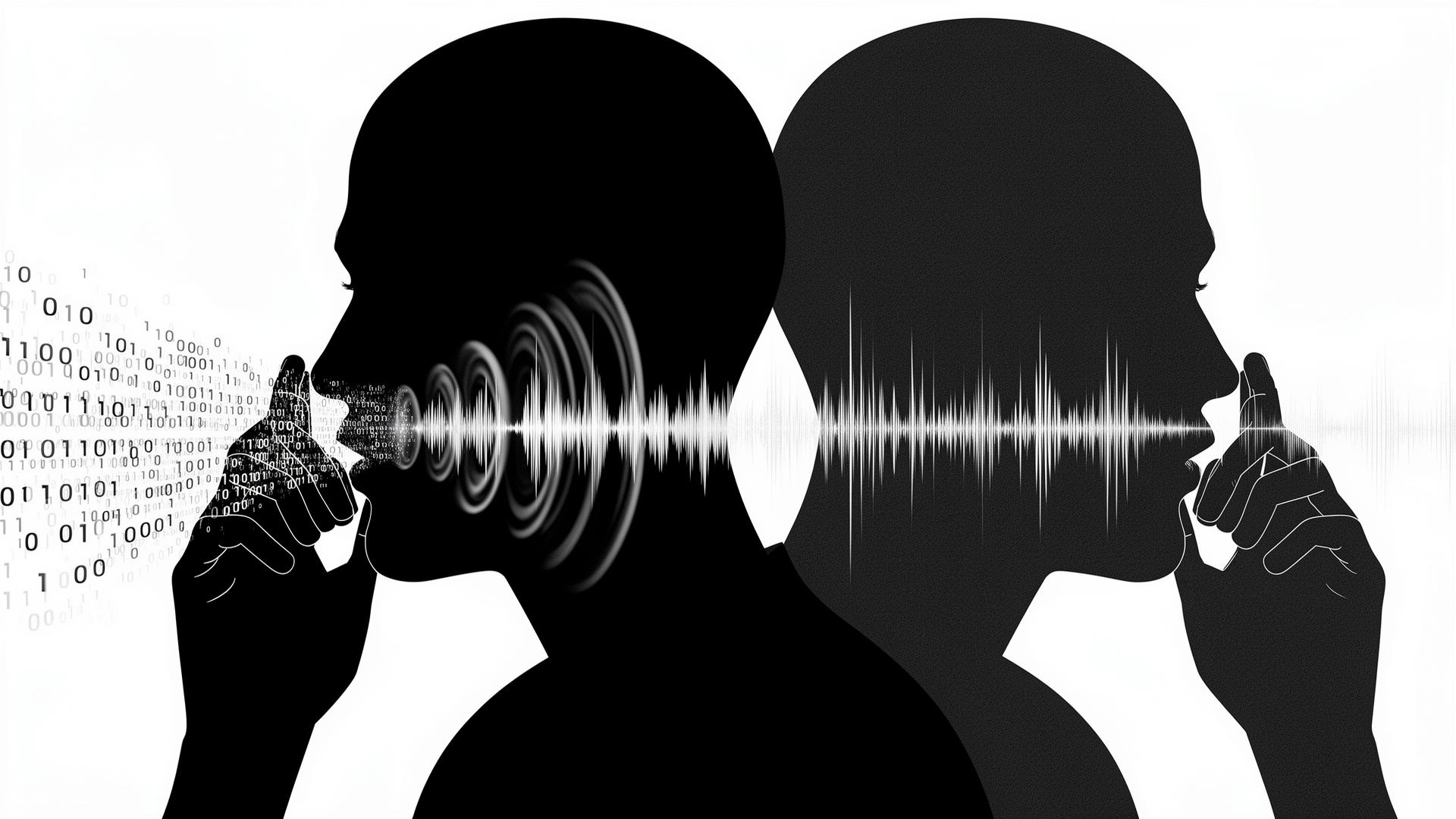
Now consider this: scammers need as little as 3 seconds of your audio to create an 85% accurate voice clone. A high-quality fake voice call costs under $1 and 20 minutes to produce. And ElevenLabs subscriptions start at $5 a month.
Voice verification is not two-factor authentication anymore. It is a costume. And the banks that still treat it as security are putting their customers at direct risk.
The Tools Are Publicly Available
This is not about nation-state actors with custom tooling. This is about commercially available software that anyone can access.
ElevenLabs is the name that comes up most often in fraud research, and for good reason. Their instant voice cloning requires just 1 to 5 minutes of audio for usable results. Their professional cloning produces near-indistinguishable output from 30 minutes of samples. The platform supports 32+ languages and ships with real-time voice conversion.
A Consumer Reports study (March 2025) assessed voice cloning products from six companies: Descript, ElevenLabs, Lovo, PlayHT, Resemble AI, and Speechify. Four of the six required only basic self-attestation to clone a voice using uploaded audio. Check a box saying you have permission. Upload any audio clip. Done.
But the details matter. ElevenLabs operates two distinct cloning tiers with very different security profiles:
Instant Voice Cloning (what Consumer Reports tested): Upload 1 to 5 minutes of anyone's audio, check a consent box, and you have a usable clone. No identity verification. No proof the voice is yours. This is the tier that fraud researchers flag, because it is sufficient for phone scams and costs $5 a month.
Professional Voice Cloning (the authenticated tier): Requires a Creator plan ($22+/month), at least 30 minutes of clean audio, and a verification step where you speak from a provided script to prove the voice belongs to you. ElevenLabs uses this to confirm consent and identity. Their AI Speech Classifier detects content made with their tools. They support the C2PA content provenance standard. These are real, meaningful safety efforts.
The problem is that both tiers coexist on the same platform. The Professional tier's safeguards do not retroactively secure the Instant tier. A fraudster does not need studio-grade cloning to fool a phone system. They need the Instant tier, which Consumer Reports found has minimal barriers. And ElevenLabs is just one of dozens of platforms. Resemble AI, PlayHT, and open-source models running locally on consumer hardware all exist. The cat is out of the bag.
OpenAI's Whisper sits on the other side of this equation. Whisper is primarily a speech recognition model, not a cloning tool, but its accuracy in transcribing and understanding speech across languages and accents has implications. Researchers use Whisper and similar models to analyse audio for deepfake artifacts, spectral anomalies, and synthetic patterns. It is part of the detection pipeline. But the same architectural understanding of speech that powers detection also informs the generation side. The technology for understanding and reproducing voice is converging.
Real Cases, Real Money
This is not theoretical.
The $193 million Hong Kong fraud ring. In April 2025, Hong Kong police dismantled a deepfake scam operation that used AI-generated video and cloned voice attacks to open fraudulent accounts at HSBC. Losses exceeded HK$1.5 billion. The voice clones were convincing enough to pass both human and automated verification.
The Arup $25 million transfer. In February 2024, a finance worker at Arup, the multinational engineering firm behind the Sydney Opera House, transferred $25 million after attending what appeared to be a legitimate video conference with the company's CFO and senior leadership. Every face was real. Every voice matched. All of them were AI-generated deepfakes created from publicly available footage.
The daily reality. Deepfake-related fraud caused more than $410 million in losses in the first half of 2025 alone. Financial services have experienced a 2,137% rise in deepfake fraud attempts since 2022. Vishing (voice phishing) surged 442% in 2025. Over 10% of banks now report deepfake vishing losses averaging over $1 million per incident.
Pindrop, a voice authentication and deepfake detection platform used by major financial institutions, processes these attempts in real time. They found that humans are only 54% accurate at detecting audio deepfakes. A coin flip. And that accuracy is declining as the technology improves.
Why Voice Biometrics Are Fundamentally Broken
A voiceprint is like a digital signature of your voice, created during an enrollment phase and matched against future calls. The problem is threefold:
1. Voiceprints are not phishing-resistant. A fraudster does not even need to trick you into transferring money. They just need you to speak for a few seconds. A phishing call where you say "Hello? Yes, this is [your name], who is calling?" gives them enough raw material. A podcast appearance, a YouTube video, a conference talk, a voicemail greeting: any of these can be harvested.
2. If your voice is online, it can be cloned. The ubiquity of social media videos, podcasts, vlogs, and public recordings means most people have already provided enough audio online to create a usable clone. You do not need to be phished. You just need to exist publicly.
3. Liveness detection is failing. Many voice biometric systems cannot distinguish between a real voice and synthetic audio in real time. The deepfake is played through a high-quality speaker or injected directly into the audio stream, and the system accepts it. Voice biometric vendors are working on detection, but the generation technology is advancing faster than the detection technology.
Sam Altman, CEO of OpenAI, said it directly: "A thing that terrifies me is apparently there are still some financial institutions that will accept the voiceprint as authentication. That is a crazy thing to still be doing. AI has fully defeated that."
BioCatch's survey confirms it: 91% of U.S. banks are now rethinking voice biometric authentication due to AI cloning risks.
The Detection Arms Race
The industry is not standing still, but the defenders are playing catch-up.
ElevenLabs' AI Speech Classifier can detect audio generated by their own platform. But it is model-specific. Audio generated by Resemble AI, VALL-E, or a locally-run open-source model will not trigger it.
Pindrop's Pulse uses acoustic fingerprinting, behavioral voice biometrics, and deep learning to detect synthetic voices in real time during phone calls. This is the most mature enterprise solution and is deployed at major banks. They can identify the specific synthesis model used.
C2PA provenance standards embed tamper-resistant metadata into audio at generation time, creating a "nutrition label" for digital media. ElevenLabs supports this. But provenance only works if the generation tool embeds the metadata and the receiving system checks for it. Malicious actors using open-source tools will not embed provenance data.
Spectral analysis looks for artifacts in the audio that are invisible to human ears but detectable by algorithms. Synthetic speech has characteristic patterns in its spectral representation. Researchers use models like Whisper to process and analyse these patterns. But as generation improves, the artifacts shrink.
The uncomfortable truth: detection is getting better, but generation is getting better faster. Gartner predicts that by 2026, 30% of enterprises will no longer consider standalone identity verification and authentication solutions to be reliable in isolation.
TTS Model Comparison: Can You Tell Which Voice Is Real?
The top models scored by blind human preference in the TTS Arena (Feb 2026).
ELO ratings from Artificial Analysis and HuggingFace TTS Arena leaderboards.
What Actually Works
If voice biometrics alone are not enough, what replaces them?
Device biometrics. Authenticate the device, not the person's voice. Behavioural analysis of how someone types, scrolls, holds their phone, and navigates an app creates a profile that is extremely difficult to spoof remotely. This runs in the background without interrupting the user.
Multi-modal authentication stacking. Do not rely on any single factor. Combine device fingerprinting, geolocation, behavioural patterns, and a traditional second factor (like a push notification to a registered device). No single compromised layer should be sufficient.
Out-of-band verification. For high-value transactions, require confirmation through a completely separate channel. If someone calls to authorise a transfer, require confirmation via the app or a registered email. An attacker who has cloned your voice still does not have your phone's biometric lock.
Real-time deepfake detection at the network level. Banks should deploy solutions like Pindrop that analyse every inbound call for synthetic audio characteristics before routing it to a human agent. This is the equivalent of scanning email attachments before they reach an inbox.
Retiring voiceprint-only auth. Any bank still using voiceprint as a standalone authentication method is operating a known-vulnerable system. The evidence is overwhelming. The regulatory direction is clear. NYDFS says deepfake detection should be part of baseline cyber programs. FinCEN has issued specific deepfake red flags. MAS in Singapore published best practices for mitigating deepfake risk across financial services in September 2025.
What You Can Do Right Now
If you bank by phone:
- Ask your bank what authentication methods they use. If the answer is "voice verification," ask what else is in the stack. If there is nothing else, you should know that.
- Minimise your public audio footprint. This is not about living in fear. It is about awareness. Every public recording is raw material for cloning.
- Enable app-based push notifications for transaction verification. This creates an out-of-band confirmation that a voice clone cannot defeat.
- Never verify sensitive information when someone calls you. If your bank calls, hang up and call them back. The real bank will understand. The fake one will not call back.
If you work in banking:
- Audit your voice authentication pipeline today. If voiceprint is a standalone factor, you have a known vulnerability in production.
- Layer, do not replace. Voice can remain as one signal among many in a multi-modal stack. But it should never be the gate.
- Deploy real-time detection on all voice channels. The technology exists. Pindrop, Reality Defender, Resemble AI's detection tools are mature enough for production.
- Train your call centre staff. They need to know that a voice that sounds exactly like the customer may not be the customer.
The Voice Is No Longer Proof
We built a financial system that trusts the sound of someone's voice. We taught people that speaking their name into a phone was a security measure. It was, for a while. It is not anymore.
The $5-a-month subscription that can clone your voice in minutes changed the economics permanently. The $193 million fraud ring in Hong Kong proved it at scale. The CEO of the company that builds these models told us directly that voice authentication has been fully defeated.
The next time your bank asks you to "say your name to verify," know that this is not protecting you. It is a legacy system running on borrowed time.
Push for better. Your bank can do better. The technology for real security exists. The question is whether institutions will move fast enough to deploy it before the losses force them to.